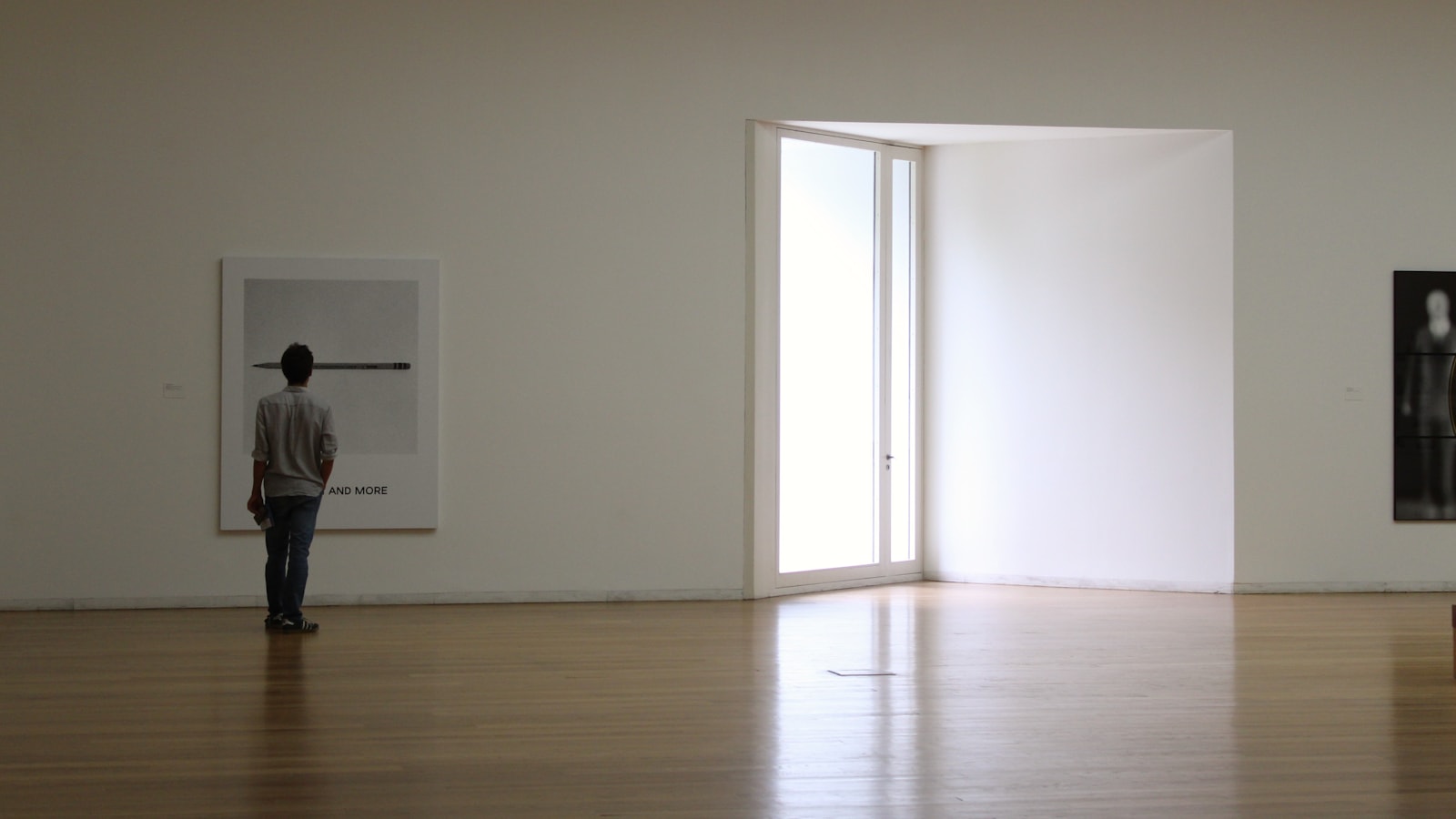
Stepping into a gallery shouldn’t feel like an exam. It’s a chance to engage directly with human creativity, and the best way to do that is by trusting your own eyes and allowing yourself the time to truly see. Forget the pressure to “get it” instantly; slow, personal observation is the real skill.
The Intimidation Problem – Why Galleries Feel Like Exams
For many, a trip to an art gallery or museum can feel less like an inspiring journey and more like a pop quiz on art history. You walk into a hushed room, surrounded by silent, knowing gazes, and rows of artworks that seem to demand a specific, intellectual response. There’s an unspoken pressure to understand the “meaning” of every piece, to recognize the artist, to grasp the historical context-all before you’ve even had a chance to simply look. This feeling is entirely normal. The very architecture of some institutions, with their grand halls and solemn atmosphere, can contribute to the sense that art is an exclusive club, accessible only to those with a specialized vocabulary and years of study. We often glance at a wall label first, hoping it will provide the “answer” before we’ve even formulated a question in our own minds. This approach, while natural, actually short-circuits the most valuable part of the art experience: your personal, unmediated encounter with the work itself.
Permission to Trust Your Own Eye
Let’s reframe this: art is not a riddle to be solved by experts alone. It is a form of communication, a visual language, and your personal interpretation, your emotional response, your intellectual curiosity-these are all valid and vital. Think of it this way: when you listen to a piece of music, you don’t immediately reach for the liner notes to understand its chord progression or the composer’s biography. You listen. You let the sounds wash over you, you notice what resonates, what evokes a feeling. Art deserves the same courtesy.
Your eye is your most powerful tool. It’s the primary interface between you and the artwork. What you see, what catches your attention, what makes you pause-these are the initial data points of your personal experience. This isn’t about being an expert; it’s about being human. Artists like Vincent van Gogh poured their souls onto canvas precisely because they wanted to evoke a feeling, to share a vision, not just to create an object for academic dissection. Trust that your unique perspective, informed by your own life experiences, is a perfectly legitimate lens through which to view any work of art.
The Method – How to See Art, Not Just Look At It
Moving beyond the initial intimidation requires a practical approach. This isn’t about learning art history overnight, but about developing habits that deepen your engagement. Think of these steps as a personal, portable toolkit for any gallery visit.
Spend Longer Than Feels Comfortable
The average museum visitor spends a mere 17 seconds looking at any given artwork. In our fast-paced world, this isn’t surprising, but it’s also barely enough time to register the basic composition, let alone truly absorb a piece. Challenge yourself to spend at least 5-10 minutes with an artwork that initially catches your attention. This might feel awkward at first, like you’re overstaying your welcome, but it’s where the magic happens.
Consider Mark Rothko’s large color field paintings. At first glance, they might seem like simple rectangles of color. But stand before one-say, “No. 14, 1960” at SFMOMA-for several minutes. You’ll begin to notice the subtle variations in hue, the feathery edges where colors meet, the way light seems to emanate from within the canvas. The flat surface gives way to an illusion of deep space, a quiet hum that only reveals itself with sustained attention. This isn’t about finding a hidden image; it’s about experiencing the painting’s atmospheric presence.
Notice What Your Eye Returns To
As you stand before a piece for an extended period, pay attention to where your gaze naturally settles. Does your eye keep returning to a particular color? A specific figure’s expression? A texture, a brushstroke, a corner of the composition? This involuntary pull is your intuition speaking, highlighting what is most compelling to you.
Perhaps it’s the intricate lace collar in a Johannes Vermeer portrait, like “Girl with a Pearl Earring,” or the swirling, almost violent brushwork in one of J.M.W. Turner’s seascapes. This isn’t about consciously analyzing; it’s about observing your own observational patterns. What draws you in? What detail holds your attention longer than others? This information is invaluable because it tells you what you find interesting, before any external input. It’s the beginning of a personal dialogue with the art.
Read the Wall Label AFTER, Not Before
This is perhaps the most crucial shift in approach. Resist the urge to scan the wall label immediately. Instead, stand before the artwork, follow the previous steps, and form your own initial impressions. What do you see? What do you feel? What questions arise in your mind? Only after you’ve engaged directly, physically, and emotionally with the piece should you turn to the label.
The label then becomes a tool to enrich your initial experience, not to dictate it. It provides context-the artist’s name, the date, the medium, perhaps a brief note on its historical significance or the artist’s intention. For example, you might look at a stark, angular portrait by Amedeo Modigliani, like “Portrait of Jeanne Hebuterne,” and notice the elongated features, the almond-shaped eyes, the overall sense of melancholic grace. Then, reading the label, you might learn about Modigliani’s short, tumultuous life, his connection to Parisian bohemia, or his influences from African sculpture. This information doesn’t replace your initial observation; it layers upon it, deepening your understanding and often sparking new insights.
Ask What the Artist Chose to Leave Out
A sophisticated way to engage with art is to consider not just what is present, but what is absent. Every artist makes choices-what to include, what to emphasize, and what to omit. These omissions can be as revealing as the inclusions.
Think about the minimalist sculptures of Donald Judd. He often uses simple, industrial materials arranged in precise, repetitive forms. What’s left out? Narrative, representation, overt emotion. The focus becomes the material, the space, the light, the viewer’s perception. Or consider a Japanese ink wash painting, where vast areas of white space are as important as the delicate brushstrokes of a mountain or a bird. The “emptiness” is not empty; it’s charged with potential, inviting the viewer’s imagination to complete the scene.
Asking about omissions forces you to consider the artist’s decision-making process and their intent. It shifts your perspective from passively receiving to actively questioning.
Here are some questions to guide this inquiry:
- What is missing from the background?
- Are there figures you expect but don’t see?
- How does the artist use negative space?
- What details are intentionally vague or generalized?
- Does the absence of color, or specific colors, make a statement?
Liking Versus Understanding – Both Are Valid Responses
There’s a common misconception that to appreciate art, you must “like” it. This pressure can be particularly acute when encountering challenging or unconventional works. It’s perfectly acceptable, even desirable, to encounter a piece that you don’t personally enjoy, but still find profoundly interesting or important.
Consider the performance art of Marina Abramović, such as “The Artist Is Present,” where she sat silently, staring into the eyes of museum visitors for hours. Many might not “like” the idea of such an austere, confrontational experience. However, few would deny its power to provoke thought about human connection, endurance, and the nature of art itself. You can understand the historical context of a Cubist painting by Georges Braque, appreciate the revolutionary way it fractured perspective and challenged traditional representation, without necessarily wanting it hanging in your living room.
Liking is an emotional response, often immediate and visceral. Understanding is a more intellectual process, built through observation, context, and reflection. Sometimes, understanding can lead to a deeper appreciation that transcends mere “liking.” Other times, you may simply respect a work for its innovation or skill, even if it doesn’t resonate with your personal taste. Both responses are valid, and both contribute to a richer art experience. Don’t feel guilty for not loving every masterpiece; your honest reaction is the most important one.
Why Slow Looking is the Whole Skill
Ultimately, the ability to “slow look” is the most valuable skill you can cultivate for engaging with art. It’s not just about spending more time; it’s about shifting your mindset from consumption to contemplation. In a world saturated with fleeting images and instant gratification, the act of deliberate, sustained observation becomes a powerful counter-practice.
Slow looking is a form of mindfulness. It trains your eye to notice subtleties, to appreciate nuances, and to connect with the artwork on a deeper, more personal level. It’s how you move beyond simply recognizing an image to truly experiencing it. This skill isn’t confined to galleries; it enhances your perception of the world around you, from the details of a city street to the expressions on a friend’s face.
By practicing these methods-spending time, noticing what draws you, reading labels strategically, and questioning omissions-you’re not just looking at art; you’re developing a dynamic relationship with it. You’re building confidence in your own judgment and cultivating an independent, informed perspective. This isn’t about becoming an art critic, but about becoming a more engaged, perceptive human being. Art is a conversation across time and space, and slow looking is how you truly join in.