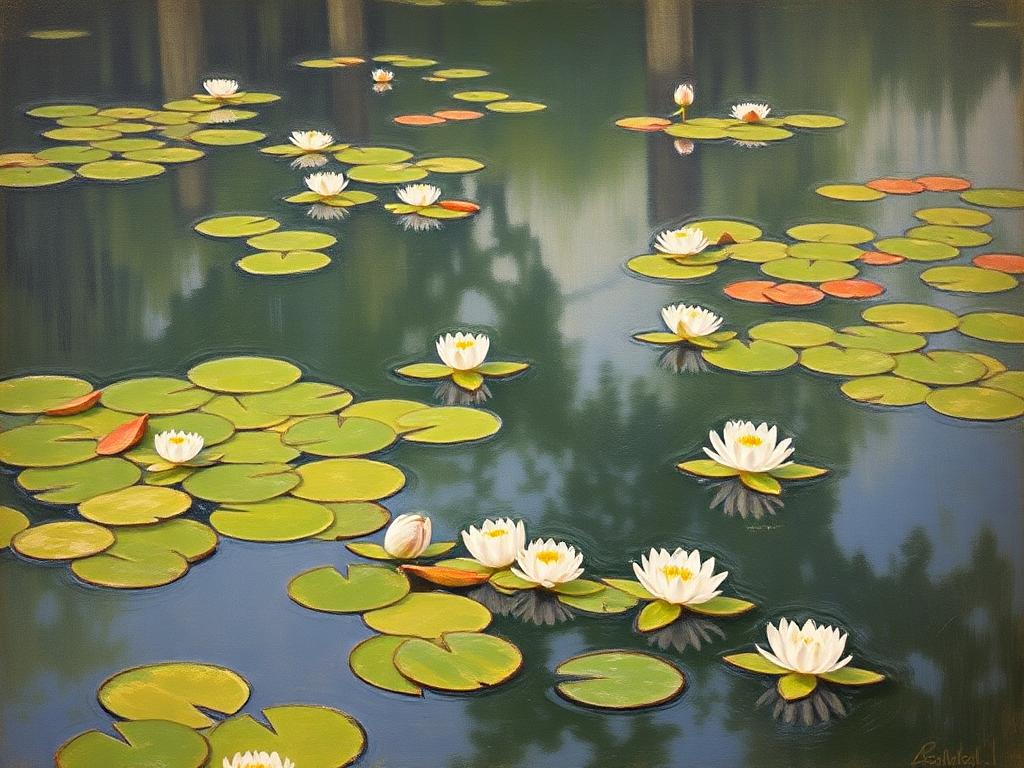
In an act of artistic resurrection, Claude Monet’s Waterlilies (1914–15) has re-emerged at the Portland Art Museum (PAM) after a meticulous two-year restoration. The project, spearheaded by lead conservator Charlotte Ameringer, stripped decades of discoloured varnish from the canvas, revealing hues and textures unseen since the painting’s creation. This revival not only honours Monet’s original vision but reignites debates about authenticity, ageing, and the ethics of intervening in an artist’s legacy.
A Century of Obscured Vision
Monet’s late-career Waterlilies series, painted in his Giverny garden, sought to capture ephemeral light and reflection through unvarnished, matte surfaces. Yet by the mid-20th century, the Portland canvas—like many Impressionist works—had been coated in synthetic varnish, a practice then deemed essential for preservation and market appeal. The result? A flattened, yellowed version of Monet’s luminous pond, its pastel-like delicacy suffocated under resin.
“Monet intentionally avoided varnish,” Ameringer explained. “He drained oils from his paints for a dry, chalky finish. The added gloss distorted his exploration of atmosphere.” Modern imaging technology confirmed the varnish postdated Monet’s death in 1926, likely applied during a 1959 restoration. Its removal became a mission to reclaim the artist’s radical aesthetic.
The Science of Subtlety
Ameringer’s process was both painstaking and perilous. Using solvent-dampened cotton swabs, she rolled away the varnish micron by micron, exploiting its chemical solubility without disturbing Monet’s oil layers. The challenge lay in balancing ambition with restraint: “You can’t erase 65 years of ageing,” she noted. Residual varnish molecules and natural oxidation mean the work will never mirror its 1915 vibrancy, but the transformation remains profound.
Pre-restoration, the pond’s surface appeared murky, its lilies dulled. Post-treatment, cadmium reds and cobalt blues resurface, while brushstrokes—once blurred—regain their tactile urgency. “Monet built texture like a sculptor,” Ameringer observed. “Thick impasto for lily pads, thin washes for reflections. The varnish had homogenised his genius.”
Monet’s Defiant Technique
The restoration illuminates Monet’s subversive material choices. By wringing oils from his paints, he achieved a desiccated finish that mimicked pastels, rejecting the glossy sheen of academic art. This technique, deemed “unfinished” by 20th-century standards, now reads as revolutionary. “He wanted viewers to feel the pond’s humidity, not admire a polished surface,” said art historian Dr. Emily Talbot. “The matte texture pulls you into the scene.”
Monet’s disdain for varnish was both aesthetic and philosophical. As he aged and cataracts dimmed his sight, his focus shifted to sensory immersion over representation. The Portland Waterlilies, painted when he was 74, exemplifies this evolution: its abstraction anticipates Rothko, its palette whispers of twilight.
Exhibition as Time Capsule
Accompanying the restored work in Monet’s Floating Worlds at Giverny are 30 Japanese woodblock prints from Monet’s personal collection, including works by Hiroshige and Toyokuni. These ukiyo-e pieces, which once adorned his Giverny home, reveal how Japanese art’s asymmetry and nature motifs influenced his compositions. A single Hiroshige print, Plum Estate, Kameido (1857), echoes in the Waterlilies’ arched bridge and floral clusters.
The exhibition also demystifies conservation science. Interactive displays compare pre- and post-restoration details, while timelapse videos document Ameringer’s process. For visitors, it’s a rare glimpse into the symbiosis of art and science—and a rebuttal to critiques that restoration “rewrites history.”
Ethics of Intervention
The project sparks broader questions: When does conservation become reinterpretation? Museums increasingly face this dilemma as technologies like AI and spectral imaging redefine possibilities. PAM’s approach, prioritising minimal intervention, aligns with the International Institute for Conservation’s ethics code. Yet as Ameringer acknowledged, “Every choice is subjective. We’re stewards, not psychics.”
Monet’s own stance complicates matters. He famously repainted earlier works to match his evolving style, suggesting a fluid view of authenticity. Would he have approved the de-varnishing? “He loathed varnish,” Talbot argued. “But he also embraced change. His garden was a living artwork—pruned, replanted, reimagined.”
A New Lens on Legacy
The restored Waterlilies challenges perceptions of ageing in art. Its lingering amber shadows and softened edges testify to time’s passage, yet its revitalised hues pulse with contemporary urgency. For Ameringer, the project transcended technical achievement: “It’s about humility. We’re not ‘fixing’ Monet—we’re listening to him.”
As the painting returns to public view, it invites a dialogue between past and present. In an era of digital replication, the tactile imperfections of Monet’s brushstrokes—now visible for the first time in decades—feel like a quiet rebellion.
Monet’s Floating Worlds at Giverny runs at Portland Art Museum from 1 March to 10 August 2025. The exhibition pairs the resurrected Waterlilies with archival letters, botanical sketches, and Ameringer’s conservation notes, offering a holistic portrait of an artist who transformed a pond into a portal. In the words of PAM director Brian Ferriso: “This isn’t just a painting restored—it’s a manifesto rediscovered.”