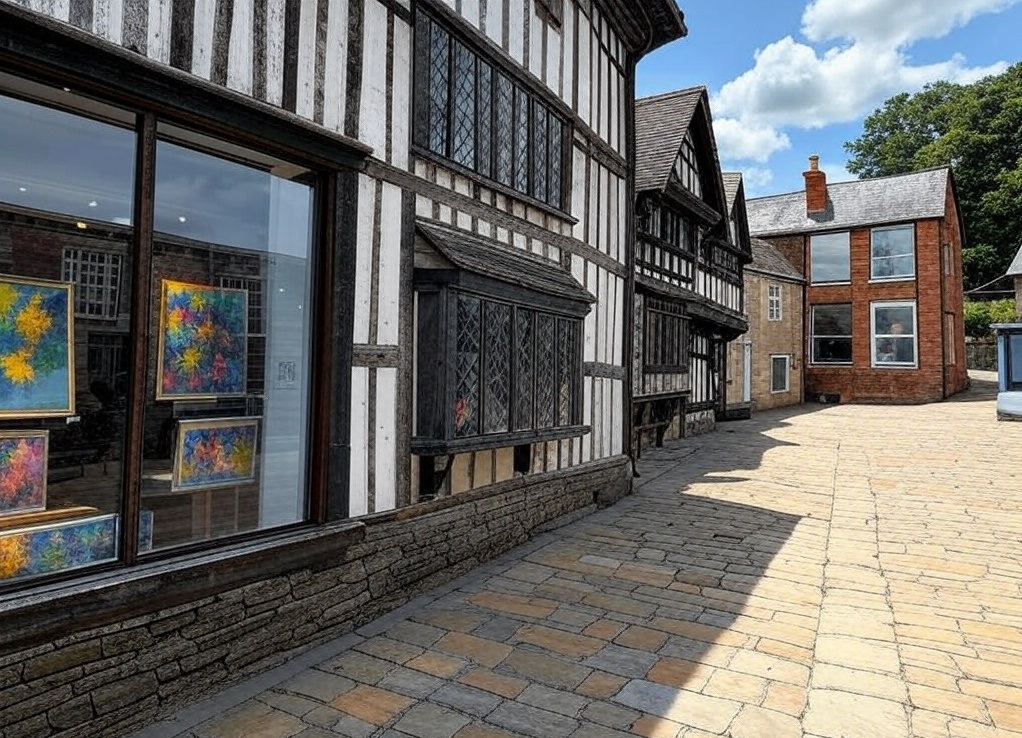
Nestled in the lush valleys of Denbighshire, Ruthin (Rhuthun in Welsh) emerges as an unassuming yet profound custodian of Welsh heritage. Beyond its cobbled streets and timber-framed façades lies a vibrant nexus where medieval history collides with avant-garde creativity. This market town, often overshadowed by its flashier neighbours, quietly thrives as a sanctuary for art lovers and cultural pilgrims. From restored Tudor mansions to cutting-edge craft studios, Ruthin’s duality—rooted in tradition yet unafraid of reinvention—offers a narrative ripe for exploration.
Ruthin Craft Centre’s Creative Pulse
At the heart of Ruthin’s artistic renaissance sits the Ruthin Craft Centre, a beacon for contemporary crafts Wales champions. Housed in a sleek, modern structure that contrasts poetically with the town’s medieval skyline, the centre is more than a gallery—it’s a living laboratory. Here, glassblowers, ceramicists, and textile artists converge, their workshops visible through floor-to-ceiling windows. Recent exhibitions have showcased everything from kinetic sculptures crafted from reclaimed slate to installations questioning Welsh identity post-Brexit. The centre’s café, with its locally sourced menu, mirrors this ethos: tradition reimagined through a modern lens.
Nantclwyd y Dre’s Timeless Tales
Step into Nantclwyd y Dre, Wales’ oldest dated townhouse, and time folds in on itself. Restored to reflect seven centuries of domestic life, its rooms whisper stories of Tudor merchants, Georgian gentry, and Victorian reformers. The walled garden, a riot of heritage roses and medicinal herbs, is a living ode to historic architecture Wales. Yet what truly captivates is the house’s refusal to be a static relic. Seasonal exhibitions—like last autumn’s display of 18th-century love letters discovered in the attic—bridge past and present, proving history’s pulse still beats fiercely in Ruthin.
St. Peter’s Square: Medieval Majesty
Ruthin’s medieval soul crystallises in St. Peter’s Square, where the 13th-century church tower looms like a stone sentinel. Inside, a 15th-century Jesse Tree fresco—a rare survivor of Cromwell’s iconoclasm—unfolds in vivid blues and golds, its branches heavy with biblical figures. Yet the square is no open-air museum. Every summer, it transforms into a stage for cultural tourism Denbighshire at its finest: the Ruthin Festival. Here, Shakespearean soliloquies echo against street art murals, and harpists duel with indie folk bands—a harmonious clash of epochs.
Ruthin Gaol’s Cultural Rebirth
Few sites encapsulate Ruthin’s metamorphosis like its Victorian gaol. Once a symbol of punitive severity, its iron doors now swing open to galleries and performance spaces. The former exercise yard hosts sculpture gardens, where twisted metalworks by local artists dialogue with the bleak brickwork. A recent highlight was Voices from the Cells, an audio-visual project where inmates’ diaries (meticulously archived by the town) were paired with ambient soundscapes. It’s a stark, stirring reminder that even spaces of confinement can become catalysts for Welsh art exhibitions that challenge and inspire.
Local Festivals and Living Traditions
Ruthin’s calendar thrums with events that blend pagan roots with contemporary verve. The annual Food Festival, held in the shadow of the castle ruins, sees Michelin-starred chefs riff on recipes from The First Welsh Recipe Book (1520). Meanwhile, the Winter Solstice Parade—a swirl of fire dancers and giant puppets—draws direct lineage from Druidic rites. These aren’t mere tourist spectacles; they’re communal acts of preservation. As local baker Enid Jones remarks while shaping bara brith loaves for the festival, “Every recipe, every dance step—it’s a letter to the future.”
Artisan Workshops and Welsh Craft
Beyond the galleries, Ruthin’s artisan workshops Wales thrive in unassuming nooks. On Clwyd Street, Einir Wyn’s pottery studio offers masterclasses where students mould clay beside a 17th-century inglenook. A stone’s throw away, woodturner Gareth Hughes crafts Welsh love spoons—not as trinkets, but as narrative objects engraved with clients’ personal sagas. These craftsmen aren’t mere traditionalists; they’re alchemists, transmuting local materials (Denbighshire oak, River Clwyd silt) into works that straddle function and philosophy.
Ruthin’s cultural landscape defies easy categorisation. It’s a place where a 14th-century castle hosts digital art projections, where the scent of molten iron from a blacksmith’s forge mingles with espresso from a vegan café. This isn’t stagnation dressed as heritage; it’s a dynamic, sometimes uneasy, dialogue between then and now. For the discerning traveller, Ruthin offers not a postcard, but a palimpsest—a town perpetually rewriting itself while staying indelibly Welsh. To wander its lanes is to witness culture not as a monument, but as a verb: alive, evolving, and defiantly unbroken.