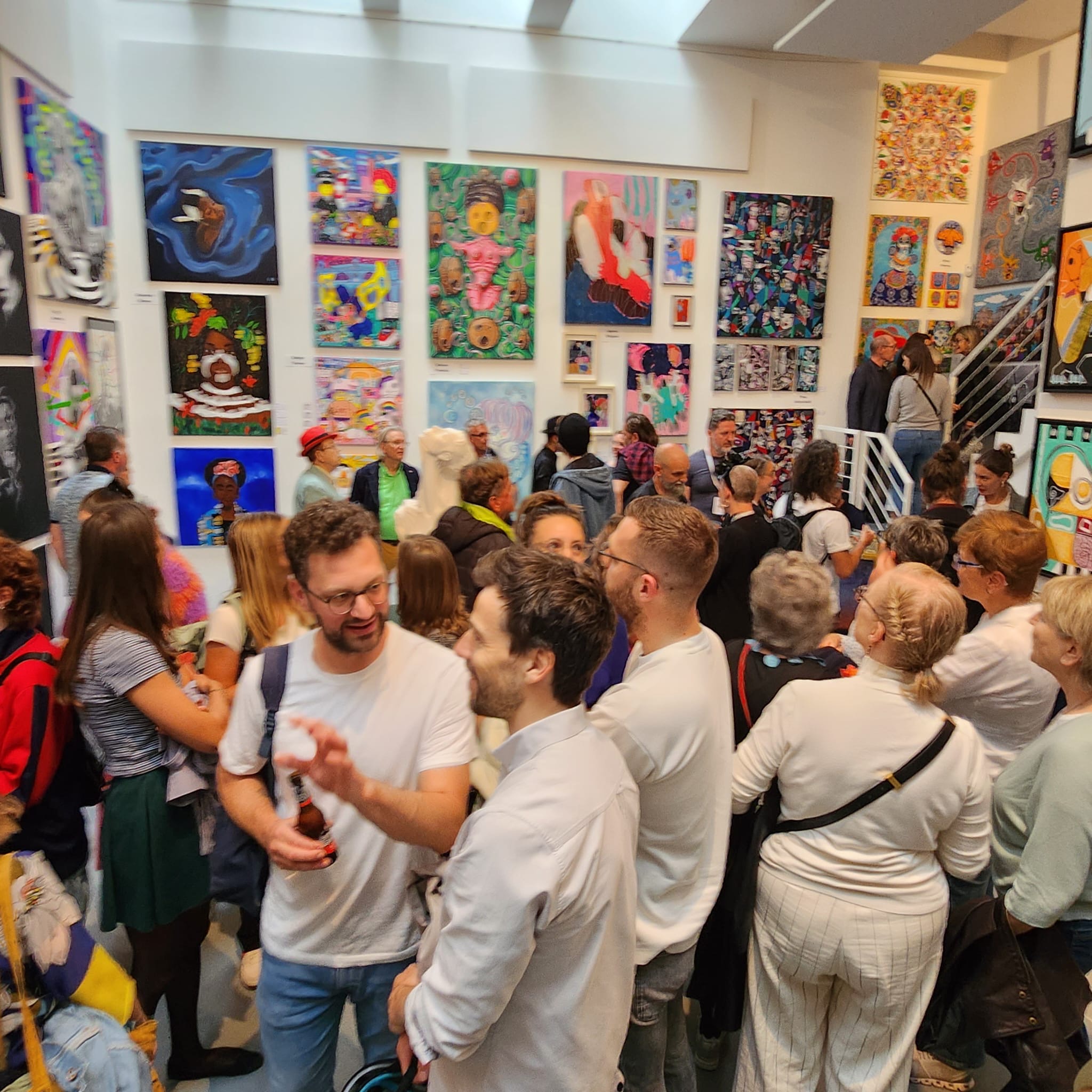
Amid the sprawling labyrinth of the 60th International Art Exhibition of the Venice Biennale, where the overarching theme Stranieri Ovunque – Foreigners Everywhere challenges our understanding of borders and identity, an equally profound interrogation of territory is taking place at the ACP Palazzo Franchetti. Here, the landscape under scrutiny is not geographical, but corporeal. Breasts, a daring and meticulously curated group exhibition by Carolina Pasti, runs as a collateral event from April through to November 2024. It marshals the work of over thirty established and emerging artists to dismantle centuries of artistic convention, reclaiming the female form from the historical grip of the male gaze.
For centuries, the breast in Western art has been heavily mediated. It has been venerated as a sacred vessel of maternal nourishment, idealised as a smooth, marble locus of classical beauty, or fetishised as the ultimate object of erotic consumption. Pasti’s exhibition disrupts this binary framework. By gathering an astonishing array of painting, sculpture, photography, and film spanning from the 1500s to the contemporary moment, Breasts strips away the veneer of patriarchal idealisation. It demands that audiences confront the female body as a site of political agency, vulnerability, trauma, and unvarnished authenticity.
The Architecture of Immersion
The physical manifestation of Breasts is as deliberate as its intellectual premise. Before encountering the artworks, visitors are required to pass through an immersive, site-specific entryway conceived by Buchanan Studio. This threshold acts as a psychological palate cleanser, forcing a transition from the bustling Grand Canal into an intimate, bodily interior.
The designers have created a tactile “pink passage,” an architectural embrace washed in the specific hues associated with breast cancer awareness. Overhead, the ceiling is adorned with exactly thirty-five breast-shaped lights, casting a warm, slightly surreal glow over the space. This design choice is not merely decorative; it is deeply conceptual. It literalises the idea of entering the female experience, transforming the breast from an object to be looked at into an environment to be occupied. By immersing the viewer in this softly illuminated, fleshy topography, Buchanan Studio and Pasti immediately destabilise the traditional dynamic between the active viewer and the passive subject. The breast is no longer isolated on a canvas; it is structural, foundational, and impossible to ignore.
From Antiquity to the Avant-Garde
The curatorial journey of Breasts is structured across five rooms, unfolding chronologically and thematically to trace the evolving iconography of the female chest. The exhibition grounds itself in antiquity and the Renaissance before vaulting into the provocations of the twentieth century.
This historical anchoring is vital. As Carolina Pasti explained to Wallpaper magazine: “Starting from a Cycladic fragment [and extending] to a Madonna lactans, my portrayal of breasts focuses mainly on post-war and contemporary artists and their approach to extremely topical issues such as feminism, breast cancer, breastfeeding, motherhood, sexuality, and the changes that have taken place over the decades throughout the world.”
The inclusion of Renaissance depictions of the Madonna del Latte (Madonna Breastfeeding the Child) establishes the baseline: the breast as a functional, holy, and entirely desexualised provider of life. This sacred archetype is then violently juxtaposed against the interventions of the Surrealists. Works by Marcel Duchamp and Salvador Dalí are strategically positioned to demonstrate the fracture point where the breast transitioned from maternal to psychological terrain. For the Surrealists, the breast was often fragmented, disembodied, and repurposed as an uncanny object. Yet, even in their radical subversions, male Surrealists frequently reduced the female form to a canvas for their own psychoanalytic anxieties. It is in the subsequent rooms, dominated by female artists, that the true reclamation begins.
The Post-War Paradigm Shift
The exhibition gains its most formidable momentum when it shifts focus to the late twentieth century, a period defined by second-wave feminism and a fierce battle over bodily autonomy. Here, the camera and the sculpting tool are wrested from the male establishment.
Cindy Sherman’s presence in the exhibition is a crucial pillar of this narrative. Sherman’s masterful use of prosthetics and self-portraiture exposes the artificiality of the male gaze. By strapping on exaggerated, plastic breasts, she mocks the societal demand for female physical perfection, turning the object of desire into a grotesque masquerade. Similarly, the inclusion of Louise Bourgeois grounds the exhibition in raw, psychological truth. Bourgeois’s varied treatments of the breast—often multiplying them across bulbous, spider-like forms or rendering them in cold, hard materials—speak to the overwhelming, sometimes suffocating reality of motherhood and the complicated architecture of female sexuality.
The exhibition does not exclude male artists entirely, but it contextualises them within this shifting dynamic. Robert Mapplethorpe’s stark, formalist photography is present, yet alongside the visceral, unsparing work of his female contemporaries, his pristine bodily studies highlight the difference between capturing a body’s geometry and experiencing its reality.
Contemporary Confrontations and Reclamations
As Breasts moves into the twenty-first century, the artwork becomes increasingly defiant, playful, and intersectional. The contemporary artists featured by Pasti refuse to be bound by a single narrative, instead offering a multiplicity of experiences that celebrate the breast in all its asymmetrical, scarred, and diverse reality.
Sarah Lucas, a stalwart of the Young British Artists movement, brings her characteristic bawdiness and sharp wit. Lucas has built a career out of substituting everyday objects—melons, fried eggs, kebabs—for female anatomy, laying bare the crude slang and inherent misogyny of tabloid culture. Her work in the exhibition forces the viewer to confront how easily the female body is reduced to consumable matter.
This theme of the disembodied breast is further complicated by artists like Laure Prouvost and Chloe Wise, who manipulate food, texture, and text to explore consumption, excess, and desire. Furthermore, the exhibition shines a necessary spotlight on rising contemporary voices. Notably, the inclusion of Adelaide Cioni with her 2021 piece To Be Naked, Breasts adds a vital layer of abstraction. Rendered in Indian ink and vinyl paint on vintage paper, Cioni’s work captures the breast as a repeated, rhythmic orb. As noted in Baring Souls: Adelaide Cioni’s “To Be Naked Breasts” – An Ode…, her minimalist approach strips away both the erotic and the maternal, leaving behind a pure, bold geometry that asserts its own presence.
These contemporary works collectively shatter the taboo of the “imperfect” body. They celebrate the breast not as it appears in airbrushed magazines, but as it exists in reality: varied, changing, and entirely unbothered by external expectations.
Beyond the Aesthetic: Illness, Motherhood, and Awareness
What elevates Breasts from a mere historical survey to a vital piece of social activism is its unflinching engagement with the realities of the physical body, specifically the trauma of illness. The exhibition does not shy away from the spectre of breast cancer; instead, it integrates it as a fundamental aspect of the female experience.
This commitment to the tangible realities of women’s health is woven into the very fabric of the event. Pasti partnered with the Fondazione IEO-MONZINO to ensure that the exhibition promotes tangible awareness and supports oncological research. This socio-political thrust grounds the artistic discourse in life-or-death stakes.
The inclusion of artists like Prune Nourry, whose work frequently grapples with bioethics, fertility, and her own diagnosis of breast cancer, provides a poignant, visceral anchor. The scarred breast, the absent breast, and the reconstructed breast are given equal space and reverence as the idealised forms of antiquity. This radical inclusion expands the definition of body positivity beyond mere self-acceptance into a profound acknowledgement of survival and resilience.
Carolina Pasti explicitly articulated this dual purpose, telling AnOther Magazine: “My idea was to portray the history of breasts throughout cultures and traditions. But I also want the audience to leave the show thinking about other topics, such as breastfeeding, breast cancer awareness … and to do this in a playful way.” It is this delicate balance—between the playful and the profound, the historical and the immediate—that makes the exhibition so compelling.
A Definitive Reclamation
As the crowds navigate the corridors of ACP Palazzo Franchetti, the cumulative effect of Breasts is overwhelming. It is a rare exhibition that manages to be simultaneously a rigorous art historical survey and a visceral, emotional experience.
By pulling together fragments of the Cyclades, the sacred milk of the Renaissance, the psychoanalytic nightmares of the Surrealists, and the defiant reclamations of contemporary feminism, Carolina Pasti has curated a definitive text on the female body in art. The exhibition proves that the breast is far more than a biological appendage or an object of sexual gratification; it is a profound cultural signifier, capable of conveying deep truths about society, power, and human vulnerability.
The legacy of this collateral event at the Venice Biennale will be its uncompromising insistence that women artists hold the pen, the brush, and the lens when documenting their own bodies. It leaves the viewer with a stark realisation: the female form has survived centuries of censorship, idealisation, and objectification. Now, unbound and entirely unapologetic, it is finally telling its own story.