Portrait painters know the hardest sitter is not the shy one. It is the sitter who already has a picture of themselves in mind and expects the painter to deliver it. You Can See Everything, the documentary by Nathan Fielder and Lance Oppenheim now showing in UK and Irish cinemas, is nearly three hours spent with a sitter of that kind.
In April 2023 Elizabeth Holmes, the founder of the failed blood-testing company Theranos, had 34 days left before she was due to start an 11-year federal sentence for defrauding investors. She and her partner, Billy Evans, invited a film crew to live with them and their two young children in a rented beach house in Del Mar, California. There had been a rumour that Holmes wanted A24 to film her life. The studio let the two directors shoot with no deadline and no promise that anything would come of it.
A comedian at the kitchen table
The choice of Fielder is half the film. The Canadian comedian made his name with Nathan for You and The Rehearsal, where a flat, polite face hides a mind that keeps testing the people in front of it. The plan was for him to stay behind the camera. His exchanges with the couple turned out to be so odd that they became the spine of the film.
At the kitchen table he asks Holmes how the Edison, the Theranos machine that was meant to run a whole panel of tests from a few drops of blood, actually worked. She explains, at length, and says her words about it had been ‘semantically misinterpreted’. He asks whether she has ever lied. She says no. He keeps going: not even at school? To show her how their conversations feel to him, he plays the couple Abbott and Costello’s ‘Who’s on First?’. Holmes laughs, and then admits she did not get the joke.
Sevgil Musaieva, editor-in-chief of Ukrainska Pravda, wrote about the film on 20 November for the paper’s culture section. She describes hearing sarcasm in Fielder’s questions in that kitchen scene, and then slowly realising she may have brought the sarcasm in herself. That is a fair account of how the film works on a viewer. Fielder gives very little away, so the audience fills the gap with whatever it already believes about Holmes.
The copy of a copy
Halfway through, the film changes shape. Filming picks up again about two years later, with Holmes in a prison camp in Texas and Evans running a new company, Haemanthus. He licenses her image for billboards and for a deepfaked AI model, and posts on X in a voice that the filmmakers do not believe is hers. A meeting early in the project, in which Evans asked for a share of the film’s profits while Holmes was in another room, was never filmed.
So Fielder rebuilds it. He brings in Amanda Seyfried, who played Holmes in the Hulu series The Dropout, and Christopher Abbott as Evans, and stages the scenes the camera missed. Seyfried appears as herself, as her old television Holmes and as a new reenacted Holmes. Earlier on, Holmes had asked to stop watching The Dropout because it upset her. Before she reports to prison she has her body 3D-scanned, and says she is worried about how her likeness might be used.
For anyone who looks at portraits for a living, this is the richest stretch. There is the woman, the actor who played her, the actor playing her again under new direction, the scan, and the licensed AI version, all in circulation at once. Each one is a likeness, and none of them settles who she is. The film never says which is closest. It puts the copies side by side and leaves the comparison to you.
Late in the film Fielder visits Holmes in prison and then rehearses the conversation with Seyfried. When he starts rewording the script, Seyfried suggests his sympathy for Holmes has bent his judgement. Early on, Fielder turned down Holmes’s offer of a swim, saying he had a rule against cold water. Near the end there is footage of him in the sea with her.
What it leaves out
Not everyone accepts the picture. Tyler Shultz, the Theranos employee who raised the alarm about its test results, praised the film’s craft in an essay for Stat but questioned its gaps. He points out that the machine Holmes shows Fielder is an unfinished prototype of a later product, not the device that sent her to prison, and that the film does not mention she lived on a $125 million estate during her trial. That is a fair objection to a film that only briefly reopens the case. On-screen text at the end notes that Evans gave up his profit-sharing deal before release.
Critical reception in America has been close to unanimous. The film holds 97 per cent on Rotten Tomatoes and won Best Documentary Feature and Best Director at the Critics’ Choice Documentary Awards on 8 November. Richard Brody in the New Yorker found it ‘strangely, poetically, poignantly beautiful’. Stephanie Zacharek in Time was cooler, praising the second half but objecting to a ‘stultifying smirkiness’. It has taken $96 million worldwide on a $7 million budget, and in its third weekend it became the first non-musical documentary to top the North American box office since Fahrenheit 9/11.
Who holds the brush
The title is a promise and a dare. You can see everything: the kitchen, the children, the breakfast, the prison visiting room. What you cannot see is the cutting room. As Musaieva notes, even a pause that reads as tenderness lasts exactly as long as the editors chose to let it run.
That is why the film belongs in a conversation about portraiture rather than true crime. Holmes spent a career managing her own image, from the black polo necks to the magazine covers. Here she meets a portraitist who will not flatter her and will not mock her, and who admits halfway through that he is no longer sure what he is looking at. The result is unfinished in the way the best portraits often are. It tells you a great deal about the sitter, a little about the painter, and quite a lot about what you brought into the room.
You Can See Everything (A24), directed by Nathan Fielder and Lance Oppenheim, is in UK and Irish cinemas from 20 November 2026. Running time 174 minutes.
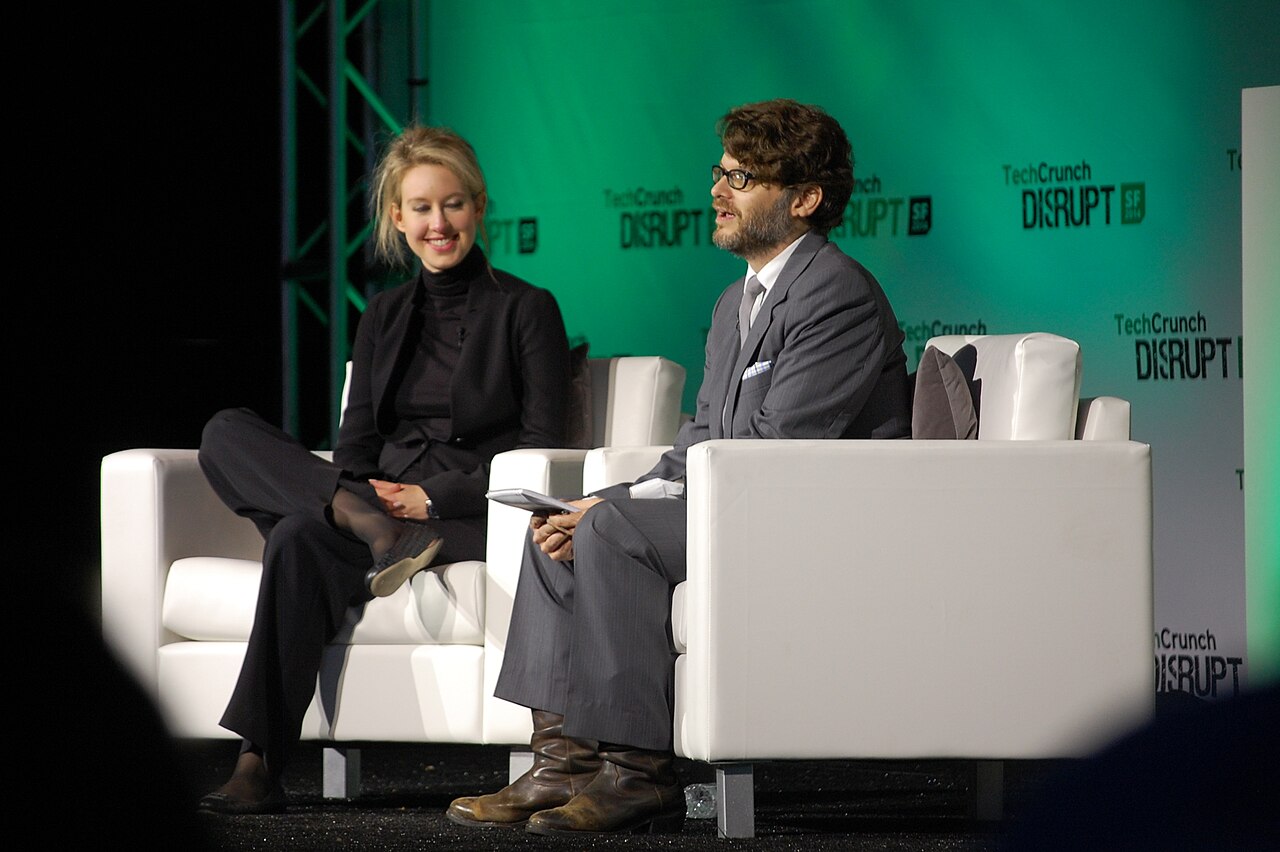
Image: Elizabeth Holmes at TechCrunch Disrupt in San Francisco, 2014. Photo: Kevin Krejci, CC BY 2.0, via Wikimedia Commons.