Art moves beyond slogans on climate change when it works with specific evidence, specific places and its own material footprint, instead of repeating messages audiences already know. The strongest examples either change something physical (a field, a city’s trees), let people step inside a plausible future, or translate local data into experience. The research is also clear about limits: a 2025 scoping review found that art reliably shifts awareness and attitudes, but no single artwork it examined directly and significantly changed behaviour on its own.
What moving beyond slogans means
A slogan compresses a position into a phrase that the viewer either accepts or rejects. Much climate imagery works the same way: a melting glacier, a polar bear, a burning forest. These pictures are true, but they are familiar, distant and easy to scroll past. They tell people what to feel rather than giving them something to examine.
Work that goes further tends to share three habits. It is specific about place and time. It shows process, so the viewer can see how a conclusion was reached. And it accounts for itself, asking what the exhibition, the shipping and the materials cost in carbon. None of these habits guarantees good art, but together they separate a considered piece from a poster.
The organisation Cape Farewell, which has run collaborations between artists and scientists since 2001, puts the ambition plainly on its site: “We all need stories that move us if we are to be inspired to make social and behavioural changes in our lives.” The word that matters there is stories. A story has particulars, characters and consequences. A slogan has none of those things.
Start with local evidence
Global averages are hard to feel. Local records are much easier to work with, and in Britain they are published every year. The Met Office’s State of the UK Climate report for 2025, published on 15 July 2026, gives an artist plenty of raw material (checked October 2026):
- 2025 was the warmest year in the UK series from 1884, and the last four years are all in the top five.
- The decade 2016 to 2025 was 1.33°C warmer than 1961 to 1990.
- The number of days over 30°C and nights over 18°C in Greater London more than quadrupled for 2016 to 2025 compared with 1961 to 1990.
- There were 297 marine heatwave days for Northwest European seas and the Northeast Atlantic in 2025, well above the previous record of 178 days in 2023.
- The total flow of rivers in England from March to August 2025 was the second lowest in a series from 1961.
Each of those lines suggests a work. Low river flows point to a stream that a village has watched shrink. Hotter nights point to sleep, bedrooms and the people who cannot open a window safely. A marine heatwave points to a harbour and the fishing families who work from it. The data gives the artist a reason to look closely at one place, and the place gives the data a human scale.
The practical method is simple. Pick one measurable change from an official source, find where it shows up near you, and spend time there. Talk to the farmer, the river warden or the allotment holder who notices it first. Then decide what form the work should take. The form should come out of what you found, rather than being chosen first and filled with climate content afterwards.
Works that change the ground itself
Some of the most durable climate art does not depict a problem at all. It alters a site.
In May 1982 Agnes Denes planted Wheatfield, A Confrontation on a landfill in lower Manhattan, two blocks from Wall Street. Her studio’s account records that 200 truckloads of soil were brought in, 285 furrows were dug by hand, and the crop was harvested on 16 August, yielding over 1,000 pounds of wheat. Denes described the paradox of growing grain on land worth $4.5 billion. The harvested wheat later travelled to 28 cities in an exhibition about world hunger, and visitors took seeds away to plant. Her later Tree Mountain in Ylöjärvi, Finland, completed in 1996, is a planted forest legally protected for 400 years, a work whose timescale is longer than any human career.
The same year as Wheatfield, Joseph Beuys launched 7000 Oaks at documenta 7 in Kassel. With volunteers he planted 7,000 oak trees over five years, each paired with a basalt stone. The stones were first piled outside the Fridericianum and removed one by one as each tree went in, so the shrinking heap became a visible measure of progress. The project was controversial at first and is now part of the city.
These works are useful models because the evidence of their effect is physical. You can count the trees. They also show the cost of this approach: years of labour, maintenance, fundraising and local negotiation. A restorative project that is abandoned after the opening becomes a monument to neglect.
Imagining a future you can walk into
A second route is speculative: building a future concrete enough to inhabit for a few minutes. The design studio Superflux made Mitigation of Shock between 2017 and 2019, a full-size London apartment set in 2050 and adapted to food insecurity and extreme weather. The studio says it interviewed experts from NASA, the Met Office and Forum for the Future, and that the installation was first shown at the Centre de Cultura Contemporània de Barcelona in the exhibition After the End of the World. Its stated aim was to leave visitors with methods and tools for living in that future, not only with dread.
Film can do something similar at a different scale. John Akomfrah’s Purple, a 62-minute six-channel video installation commissioned by the Barbican and premiered in its Curve gallery in October 2017, combines archive footage, new film, spoken word and music across locations from Alaska and Greenland to rural Scotland and the Marquesas Islands. Akomfrah, who represented Britain at the 2024 Venice Biennale, described Purple as a response to the Anthropocene. Its power comes from accumulation and juxtaposition. No single image carries the argument; the connections between them do.
What the research says about effectiveness
Claims that art “raises awareness” are common and rarely tested. One useful check is a 2025 scoping review in Frontiers in Psychology by Kafui Gbeve and colleagues, Influencing pro-environmental behaviors through visual arts. The authors screened empirical papers published between 2001 and 2024 and selected eight studies that assessed artistic interventions. Across films, festivals, exhibitions, murals and immersive installations, they found that none directly and significantly affected behaviour, but all affected environmental attitudes or awareness to some degree. They also identified co-creation and supplementary material as features that can strengthen a project’s influence.
That finding should reassure and discipline artists in equal measure. Art is good at changing what people notice and how they feel about it. It is weak as a stand-alone behaviour change tool, which means projects work best when they connect to something people can actually do next: a local flood group, a tree planting day, a repair café.
A second study is a warning about shortcuts. In 2026 Fabian Bünzli and Martin Eppler published three experiments with 2,580 participants on realistic AI-generated images of climate disasters. The images intensified emotional responses but also produced resistance and reduced trust in the source. When people suspected an image was AI-generated but this was not disclosed, their willingness to make personal sacrifices for climate action fell significantly. For artists and curators, the lesson is about honesty of means: a viewer who feels manipulated stops listening.
The footprint behind the frame
Climate art shown in a gallery that flies works around the world sits in an awkward position, and audiences notice. The sector now has tools to measure this. The Gallery Climate Coalition, a registered charity, aims to cut the visual arts sector’s emissions by at least 50% from a 2019 baseline and reach near-zero waste by 2030, and offers its tools free of charge, as stated on its about page (checked October 2026).
Its Stocktake Report 2025 draws on six years of carbon calculator data. The accompanying press release of 14 November 2025 reports that 79% of members who began tracking in 2019 had already cut emissions by more than 25%. It also found that flights, freight and building energy account for 80 to 95% of operational emissions across member types, and that the largest 22% of organisations produce around half of sector emissions. GCC director Heath Lowndes is quoted: “Art has always shaped how society thinks and feels. To use that influence responsibly in the face of the environmental emergency, we must first transform how our own industry operates.”
In England, publicly funded organisations report their environmental data through the free Creative Climate Tools run by Julie’s Bicycle, a non-profit that says it has supported more than 2,000 cultural organisations (checked October 2026). The Arts Council England Environmental Annual Report 2024 to 2025, produced with Julie’s Bicycle, covers National Portfolio Organisations from 1 April 2024 to 31 March 2025.
For individual artists, the same “big three” apply at a smaller scale. Local materials, sea or road freight instead of air, shared transport for installation crews and designing work for reuse all count, and they are part of the work’s meaning as much as its budget.
Questions to ask of any climate artwork
When you review or visit a climate show, a short set of questions keeps judgement honest:
- Is it specific? Does the work name a place, a period or a measurable change, or does it use climate as a vague mood?
- Does it show its sources? Can you trace where the data, stories or materials came from?
- What does it ask of the viewer? Contemplation is legitimate, but notice whether the work offers any connection to action or simply leaves people anxious.
- What did it cost? Look for information on shipping, energy and what happens to the materials afterwards. A growing number of venues publish this.
- Who is it for? A work in a city gallery reaches a different public from one in a village hall, a bus shelter or a farm.
The fifth question matters for a title like ours, based in Ruthin in north Wales. Our independent coverage on the Visionary Art homepage and wider arts writing at Art Culture both give attention to work made outside the big centres, where climate effects such as river levels and changing seasons are often most visible.
Frequently asked questions
How does art address climate change?
Art addresses climate change by translating evidence into experience. It can document a local change, restore a site physically as Agnes Denes and Joseph Beuys did, or build a believable future people can enter, as in Superflux’s Mitigation of Shock. The most credible work is specific, honest about its methods and aware of its own carbon footprint.
Is climate art effective?
Evidence suggests climate art changes awareness and attitudes more reliably than behaviour. A 2025 scoping review of eight studies found no artwork that directly and significantly changed behaviour on its own, though all shifted attitudes or awareness to some degree. Art is most effective when linked to practical next steps and when its makers reduce their own emissions.
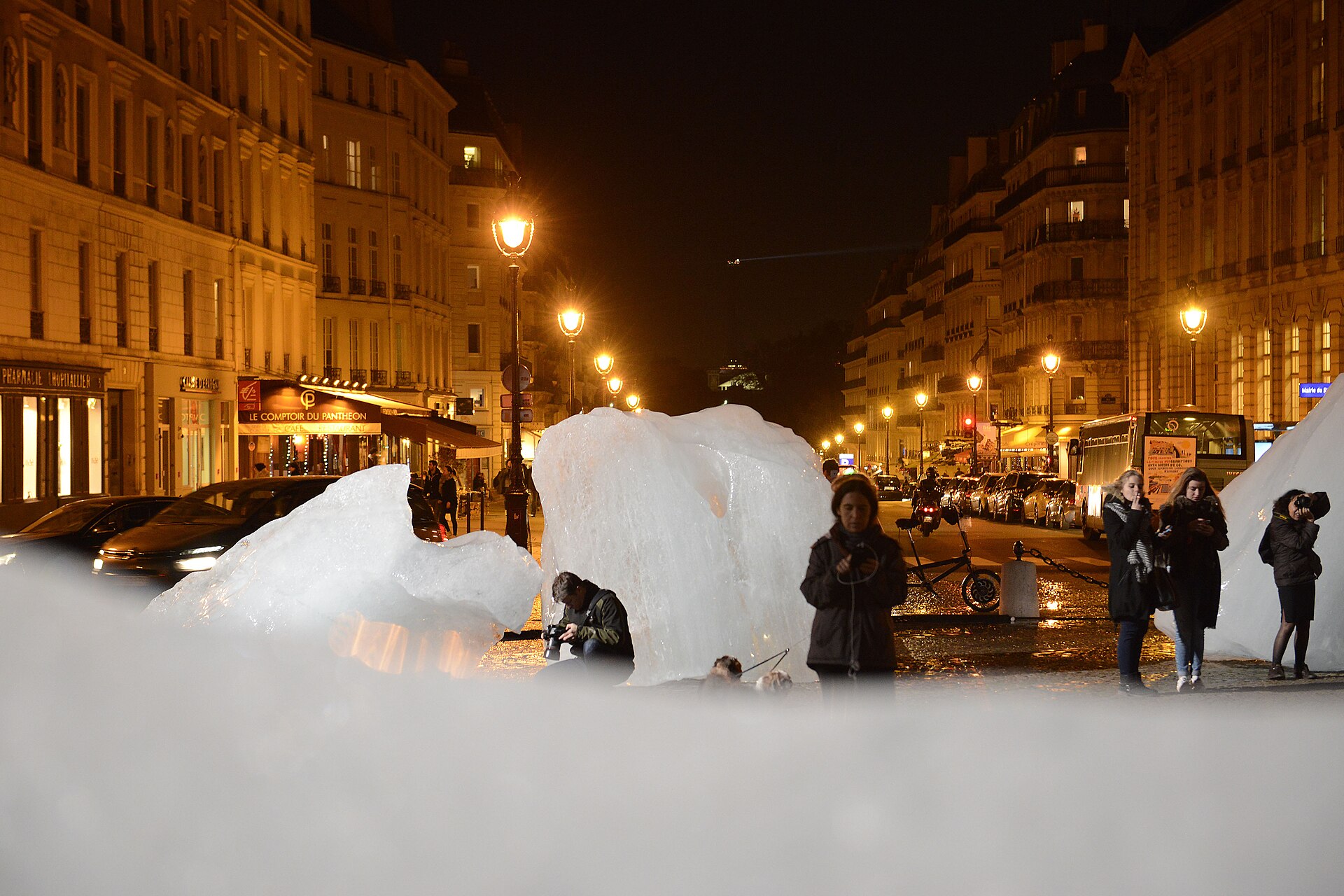
Photo: UNclimatechange from Bonn, Germany, CC BY 2.0, via Wikimedia Commons