An art review is trustworthy when a reader can check how the critic got from the work to the verdict. That means accurate description that another visitor could confirm, criteria that are stated rather than implied, opinion kept visibly apart from fact, any personal connection declared, and errors corrected in the open. A trustworthy review does not have to be neutral or agreeable; it has to be honest about its evidence and its limits.
Trust is about method, not agreement
Art criticism is opinion, and nobody should expect a critic to be objective in the way a scientist or an auditor is. What readers can expect is a method they can follow. The standard account of art criticism describes a descriptive stage, in which the work is translated into words sufficiently for a case to be made, followed by evaluation that depends on both the work and the critic’s experience. A review earns trust when both stages are visible on the page.
History gives good reason for humility. The same account notes that critics of the past are often mocked for dismissing artists now admired, and that labels such as “Impressionism” and “Cubism” began as insults. A trustworthy critic writes knowing that judgements age, and so shows the reasoning rather than relying on authority.
The profession takes this seriously. The International Association of Art Critics (AICA), founded in 1950, says on its official site that it unites over 5,000 art professionals from 95 countries and exists in part to protect “the ethical and professional interests of its members” (checked October 2026).
Description another visitor could check
The first test is simple: could someone who saw the same exhibition confirm what the review says is there? Medium, scale, number of works, the order of rooms, the length of a film, the condition of the lighting. These are facts, and they should be right. A review that gets the medium wrong or misnames a work has given you a reason to doubt its judgements as well.
Good description also shows where the critic’s attention went. When a review calls a painting “quiet”, the claim only becomes useful once you know whether the quiet comes from thin paint, a narrow tonal range, empty space or the absence of figures. Concrete detail lets you test the adjective against your own experience of the work.
Watch for vagueness that hides a lack of looking: a show summarised from its press release, artists’ names and titles but no physical detail, or a verdict that would fit any exhibition. Those are signs the critic may not have spent long in the room.
Stated criteria and a visible basis for opinion
Trustworthy reviews say what they value. One critic prizes formal invention, another technical control, another the clarity with which a show makes an argument about history or society. None of these is wrong. What matters is that the reader knows which standard is being applied and can see it applied consistently across artists, large institutions and small ones.
UK law has arrived at a similar idea from another direction. In England and Wales the defence of “honest opinion” under section 3 of the Defamation Act 2013 depends on three conditions: the statement was one of opinion, it indicated “whether in general or specific terms, the basis of the opinion”, and an honest person could have held it on the basis of facts that existed when it was published. That is a legal test, not a style guide, but it describes a trustworthy review rather well: an opinion with its basis on show.
The most famous counter-example in British art writing is John Ruskin’s 1877 attack on Whistler’s Nocturne in Black and Gold: The Falling Rocket. Ruskin accused the painter of asking “two hundred guineas for flinging a pot of paint in the public’s face”, and, as the account of the trial records, Whistler sued. In November 1878 a jury found in his favour but awarded a farthing in damages, and the costs helped bankrupt him by May 1879. The episode is still read as a warning about insult standing in for argument, on both sides.
Fact and opinion kept apart
Every serious code of journalistic practice in the UK makes the same demand. The National Union of Journalists’ code of conduct, which has set out principles for UK and Irish journalism since 1936 and was last updated in 2011, says a journalist “differentiates between fact and opinion” and “does her/his utmost to correct harmful inaccuracies”. The Guardian’s editorial code of practice, in its March 2026 edition, says a publication “must distinguish clearly between comment, conjecture and fact”.
The same document reprints C.P. Scott’s centenary essay of 5 May 1921, with its line “Comment is free, but facts are sacred”, and the less quoted sentence that follows soon after: “It is well to be frank; it is even better to be fair.” Those two sentences are close to a full definition of a trustworthy review. The critic is free to judge; the dates, titles, prices and quotations must be correct.
In practice, look for reviews that signal the shift. “The gallery says the works were made during a residency” is reported fact with a source. “The later paintings feel rushed” is opinion. A reader should never have to guess which is which.
Independence and declared interests
Art is a small world. Critics know artists, curators teach critics, and writers sometimes curate. None of that automatically makes a review untrustworthy, but undisclosed connections do.
Newsroom codes are specific about this. The Guardian’s code says it is “always necessary to declare an interest” when a journalist writes about something with which they have a significant connection, and that a journalist generally should not write about a relative, partner or close friend. On gifts, it asks for anything other than perishable or low-value items (under £50) to be returned or given to charity, and items supplied for reviews to be returned.
The New York Times’ Ethical Journalism handbook goes further for culture writers. Staff who cover artistic performances may accept the press passes customarily offered to media, but staff are told not to contribute to the programmes of museums or theatres, and to avoid judging competitions involving people they cover, with “juried art prizes” given as an example. Its critics may conceal their affiliation where needed to avoid special treatment.
Smaller publications rarely have handbooks this long, but the questions transfer. Does the critic disclose links to the artist or gallery? Does the publication say who wrote the piece? Would the review read differently if the connection were known?
Clear labels and honest corrections
A reader should be able to tell at a glance whether a piece is a review, an interview, a preview, a profile or a promotion. In the UK, the advertising rulebook administered by the ASA states in rule 2.1 of the CAP Code that “marketing communications must be obviously identifiable as such”. The Digital Markets, Competition and Consumers Act 2024 lists, in Schedule 20, submitting or commissioning fake consumer reviews among the commercial practices that are always treated as unfair, defined as reviews that purport to be, but are not, based on a person’s genuine experience. That law is aimed at customer ratings rather than criticism, but it reflects a shared principle: readers are entitled to know what kind of text they are reading.
Corrections are the other half of labelling. The Guardian’s code requires significant inaccuracies to be corrected “promptly and with due prominence”, and the paper publishes a running corrections and clarifications column. The New York Times states that it is its policy “to correct our errors, large and small, as soon as we become aware of them”. A publication that corrects in public, rather than quietly rewriting a review after a complaint, is one whose other judgements you can lean on.
A reader’s checklist
Before you rely on an art review, run through these questions:
- Description: could you picture at least one work from the text, and do the details match the gallery’s list of works?
- Criteria: does the critic say what they value, and does the verdict follow from it?
- Evidence: are strong adjectives tied to something specific in the work?
- Fact and opinion: is it clear which sentences report and which judge?
- Limits: does the critic mention anything they could not see or hear properly, or a first visit that left questions open?
- Interests: are any links to the artist, gallery or curator declared?
- Labelling: is the piece clearly marked as a review rather than a feature or a promotion?
- Track record: does the critic’s other writing show consistent standards, and has the publication corrected errors openly?
No single review will pass every test perfectly, and a review that fails one is not necessarily worthless. The pattern matters more than any one item.
Partial, but not hidden
Oscar Wilde had his speaker Gilbert argue, in “The Critic as Artist” (collected in Intentions, 1891), that the highest criticism “is the record of one’s own soul”. Few readers want a critic’s soul in place of an account of the exhibition, but Wilde’s point stands: criticism is personal. The answer is not a pretence of neutrality. It is transparency about standpoint, evidence and connections, so that a reader can disagree with the verdict and still trust the account.
At Visionary Art, an independent cultural review with a gallery in Ruthin, north Wales, these are the standards we hold our own reviews to. The best test for any review, here or elsewhere, is whether a reader who visits the show afterwards finds the description accurate and the reasoning fair, even when they reach a different conclusion.
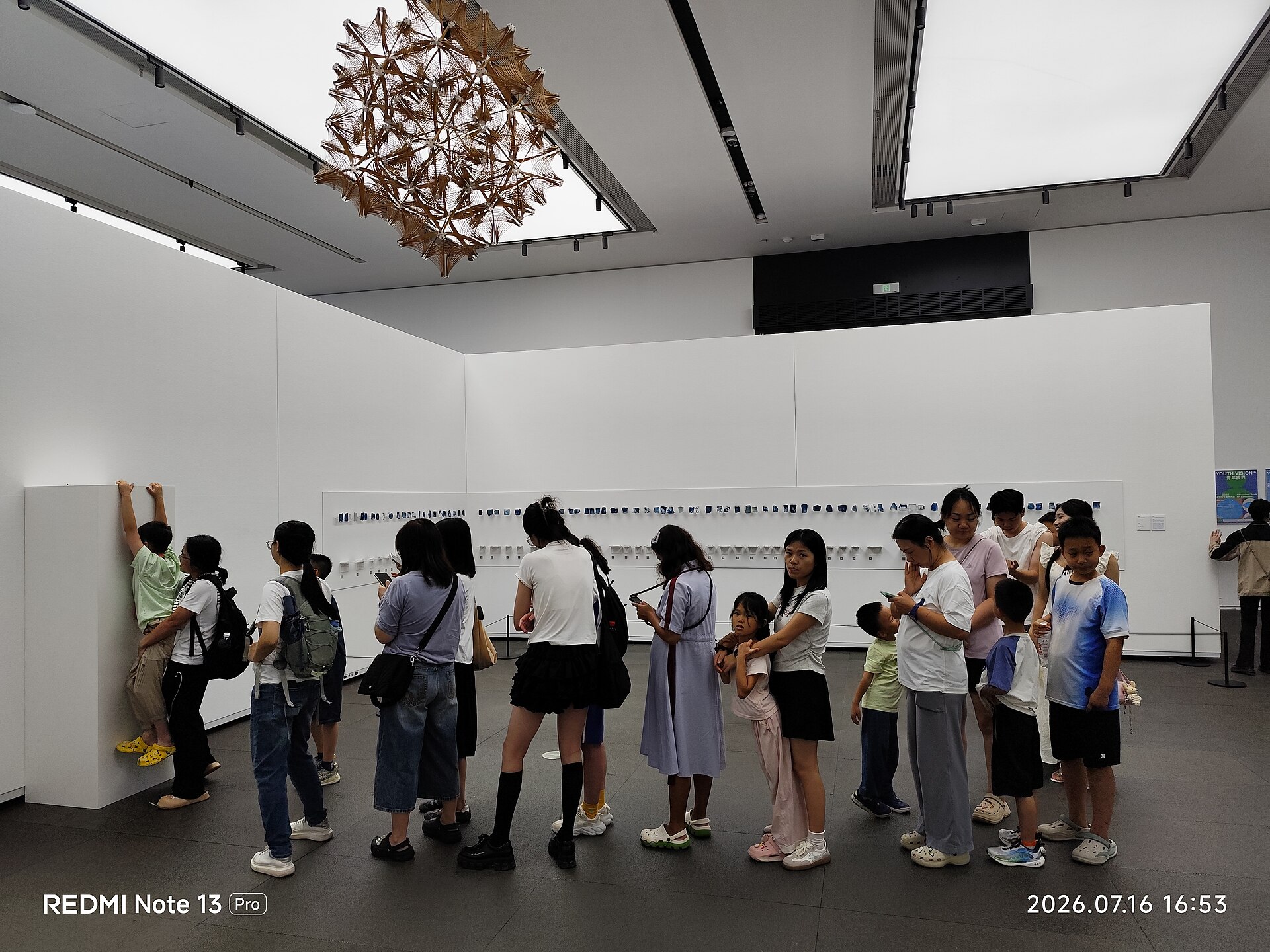
Photo: BSOWN yamewl CHUNG Wuoo, CC0, via Wikimedia Commons